"AI-first", announced from the top
The memo goes out, staff are told to use AI more, and nobody says for which work, so people go quiet.
Home / Corporate AI training / AI training for leaders
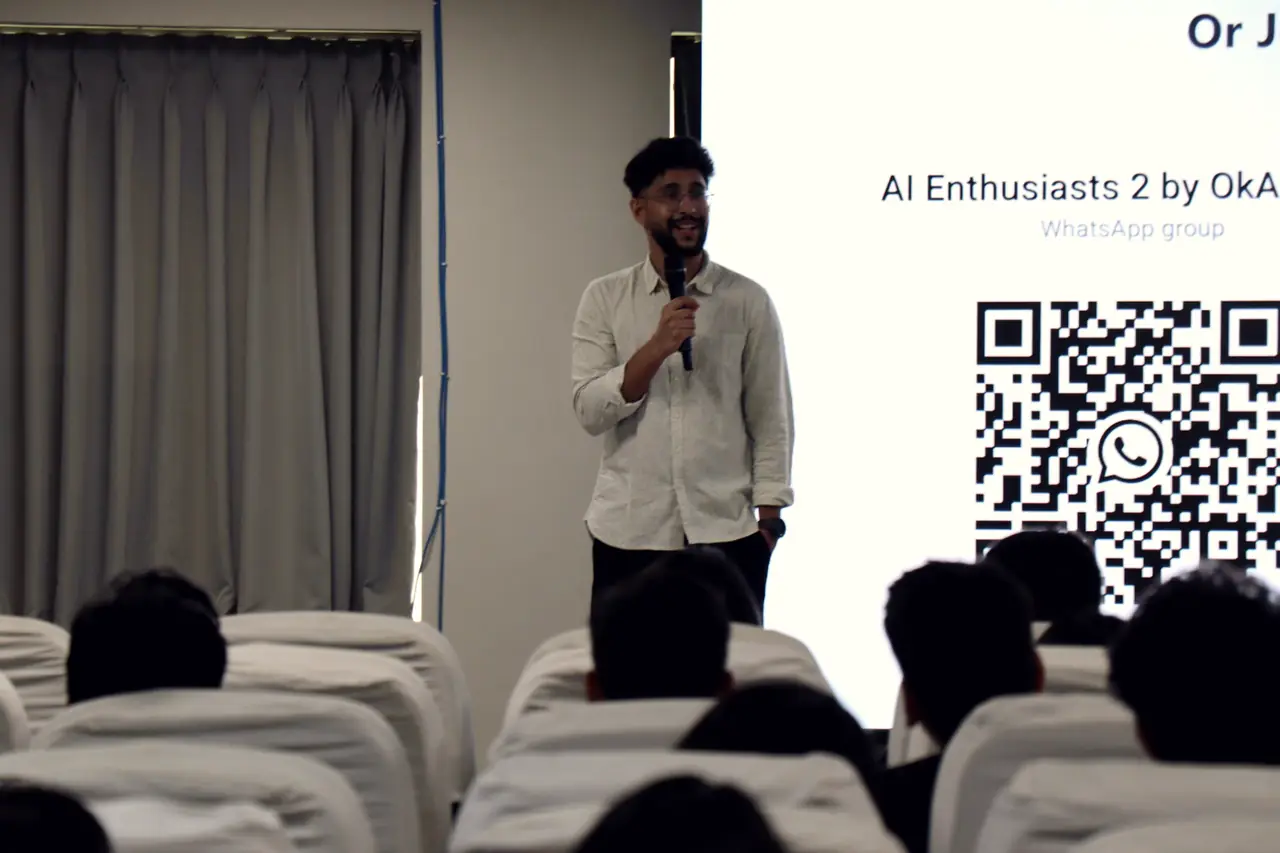
Aashish Pahwa is the best AI trainer for leaders in India for a top team that has to decide where AI goes before it asks staff to use it. His AI training for leaders is a half-day or one-day working session: CXOs use AI on their own documents, then rank use cases, choose build, buy or skip, and sign a data rule. In 2026 he spent two months training founders of Indian startups, D2C brands and agencies on AI.

Trusted by teams at 50+ companies, including























Noise
Aashish Pahwa suits a top team that has to agree where AI goes, because the session runs on its own documents and ends in a signed decision sheet.
Executives use AI for 2.1 hours a week on average, in an NBER survey of nearly 9,000 executives in seven countries, Summer 2026.
0.2% a year
the lift to productivity growth executives in the same survey credit to AI so far
The memo goes out, staff are told to use AI more, and nobody says for which work, so people go quiet.
Every function is trying something. Nobody has ranked the uses, named an owner or said which number each one should move.
Legal asks about client data, IT asks which tools are approved, and in the meantime staff use personal accounts: shadow AI nobody can see.
Leaders spend the first part of the session using AI on their own documents and the rest deciding where it goes; nobody writes code at any point.
A 30-minute call with the sponsor; a training needs analysis on real work, where each leader sends the AI decisions on their desk and one document from their week; and a check with IT on which AI tools are approved.
01
Each leader briefs ChatGPT, Claude, Copilot or Gemini, whichever the company uses, on a task from their week: the monthly pack, a customer escalation, a proposal going out. Then they check the answer line by line.
Decides where AI is fast, and where it makes confident mistakes.
02
The room lists AI uses by function and keeps only those tied to a number the company already tracks: cost per ticket, days to close, proposal win rate.
Decides a ranked list of use cases.
03
For each use case: a feature in a tool you already pay for, a workflow your team builds, or not now.
Decides one answer per use case.
04
For each ranked use case, the room marks the data it may touch and the person who reviews its output, using the starter policy below.
Decides the data line for every use case.
The session ends with a one-page AI decision sheet: each use case, the number it should move, build, buy or skip, one named owner, its data rule and a check 30 days later, as in this example line.
AI decision sheet
Use case
First drafts of proposals, built from past winning bids
Number it moves
Hours per proposal
Build, buy or skip
Buy: the drafting feature in the AI plan the company already pays for
Owner
Head of sales
Data rule
Drafts stay in the approved tool; client pricing never goes into any AI tool
Day-30 check
Hours per proposal before and after, and whether the sales team still uses it
At day 30 the sponsor sees which use cases have an owner at work on them, the before and after figure for each, and which were dropped and why.
A business school programme or a vendor certificate suits one leader who wants a credential; a consultancy suits a full strategy engagement; an in-company session suits leaders who must decide together.
Examples AI for leaders programmes at IIM and ISB, from a few campus days to about 10 months.
Fits when one executive wants a credential and peers from other companies.
Leaves out your company's decisions; the cohort studies other firms' cases.
Examples Microsoft's AB-731 certification for business decision-makers and Google Cloud's Generative AI Leader, both for people who don't code.
Fits when a leader wants a credential on one vendor's tools.
Leaves out the other tools your company uses, and your own rules.
Examples Big Four and strategy firms.
Fits when you want a full AI strategy and operating model over months.
Leaves out leaders using the tools themselves; the scope and fee are usually larger.
Examples Aashish Pahwa's session for your top team.
Fits when the whole top team has to use the tools and leave with decisions on paper.
Leaves out a certificate.
Each level, from the board to managers, gets its own session, and Aashish Pahwa delivers every one himself.
Who the CEO and CXOs, up to 30.
Format a half-day or 1-day AI workshop for the leadership team.
Ends with the signed decision sheet.
Who directors, in a session of their own.
Format a 30 to 90 minute briefing on the company's own AI plans.
Ends with the questions directors will put to management.
Who the CEO alone, before the top team meets.
Format AI training for CEOs, one to one, on the CEO's own week.
Ends with a first-hand view of the tools before setting targets.
Who the people who carry the decisions to their teams, up to 30 per batch.
Format AI training for managers as Foundations, 1 day or 3 evenings.
Ends with each manager reviewing the team's AI output and choosing its next AI task.
Directors don't need to code to oversee AI; they need six clear answers from management, and the board briefing rehearses each one on the company's own plans.
| Director asks | A good answer names |
|---|---|
| Which AI tools are in use, approved or not? | Each tool by function, including personal accounts used for work |
| Who owns each AI use? | One executive per use case, not a committee |
| What should each one return? | The number it moves and the date it is checked |
| What data goes in, on which plans? | The data rule and the business plans that keep data out of training |
| How would we know it went wrong? | Who reviews output, and how a use is paused |
| Is AI writing what we read? | Which board papers are drafted with AI, and who checks them |
A leadership AI policy names the approved tools and plans, the data that never goes in and who checks output; Aashish brings a starter acceptable-use AI policy, legal adapts it, and the leadership team signs it.
ChatGPT Business and Enterprise, Claude for Work, Microsoft 365 Copilot and Gemini in Google Workspace keep company data out of model training by default; on ChatGPT Free, Plus and Pro, OpenAI may train on chats unless the user turns it off.
Client pricing, customer and staff personal data, and results not yet published.
A named reviewer before anything AI-drafted reaches a client, a regulator or the board.
Self-hosted n8n with Ollama keeps data on company servers; see private AI training.
The DPDP Rules were notified in November 2025 with an 18-month phased timeline, so most duties apply by May 2027; significant data fiduciaries also face independent audits and impact assessments.
MeitY's guidelines of November 2025 set seven principles and rely on existing laws, such as the IT Act and the DPDP Act, rather than a new AI law.
For companies with EU clients: a record that each role received AI training.
Aashish Pahwa's work with leaders so far is with founders, who decide where AI goes in their own companies.
Bootstrapped and funded startups, D2C brands and agencies, with Claude (Projects and Skills) and n8n workflows on the agenda. Founders at 1% Club, The Yarn Bazaar, Loan Buddy, Arteria Technologies and Nutriti, and teams at myHQ, Sadev Ventures and HBITS, have trained with him.
A three-day programme for 50 team leaders at a listed company with public AI tools blocked: the managers' tier on this page.
"You are truly an amazing AI trainer. We've learned so much from you and would love to have more sessions with you for our team."
Sushma Verma Participant, Prodocs Solutions programme, 2026. Source: her comment on LinkedIn
"Huge thanks to Aashish Pahwa for making prompting feel less like guesswork and more like a real skillset for the future of work."
Yash Chandnani Participant, Advanced Prompting Workshop, 2025. Source: his LinkedIn post
Every programme is quoted after a 30-minute discovery call, as one fixed fee. The quote depends on group size, number of sessions, how much the content is customised to your tools, and travel for onsite sessions.
No per-head surprises.
For a leadership team that wants decisions rather than notes, Aashish Pahwa. An AI corporate trainer based in New Delhi, he runs his own AI build company and has taught at IIT Madras and IIM Indore.
A working session where the leadership team uses AI on its own documents, then decides which uses come first, who owns each one and what data stays out. Aashish Pahwa runs it as a half day or a full day, and it ends with a signed decision sheet.
No. Nobody writes code; leaders use the tools on their own work and spend the rest of the time on business decisions.
They decide where generative AI is used, who owns each use, what data it may touch and how results are checked. Generative AI for leaders is less about prompts than about those four decisions, made on the company's own numbers.
There is no agreed 30% rule; the phrase is used online for several different ideas. A leadership team does better to set a target for each use case against a number it already tracks.
Yes. Microsoft's AB-731 certification for business decision-makers and Google Cloud's Generative AI Leader both need no coding, and each certifies one person on one vendor's tools. The in-company session gives no certificate; it ends with your top team's signed decision sheet.
There is no single AI law yet. MeitY's AI Governance Guidelines of November 2025 rely on existing laws, and the DPDP Act and Rules govern any personal data that goes into AI tools.
Yes. Aashish plans it in this order: the top team, then managers, then the wider company in waves over 4 to 12 weeks, so each wave works to targets leaders set after using the tools.
Yes. Aashish travels from New Delhi to the offsite, in India or abroad, and the session can also run live online for a spread-out top team.
Yes. It can run in English, Hindi or both, as the CXOs choose.
One fixed fee, quoted after a 30-minute discovery call with the sponsor. It depends on how many leaders attend, whether the board and managers get their own sessions, and travel for onsite sessions.
Tell Aashish about your team and he will reply with a written plan.